Vistas de página en total

miércoles, 30 de septiembre de 2015

Papel engomado 8, La Cena. Piezas para la exposición

 Acaymo S. Cuesta - Pulsión (2015) y Tesoro de significantes (Chago) (2015)

 rosa mesa - Con el pie en la boca (Díptico 2015)

 Eva Hiernaux - La Cena I y II (2015)

 Adassa Santana - La última cena I y II (2015)

Joaquín Artime - Evidencias I y II (2015)

Karina Beltrán - La Cena I y II (2015)

Mar Lozano - Palabra-Reverso I y II (2015)

Luna Bengoechea - Retratos con guarnición (Rebeca) y Retratos con guarnición (Christian) (2015) 

Ricardo Montesdeoca - Soup nucleoside in nitrogenous base (Díptico) (2015)
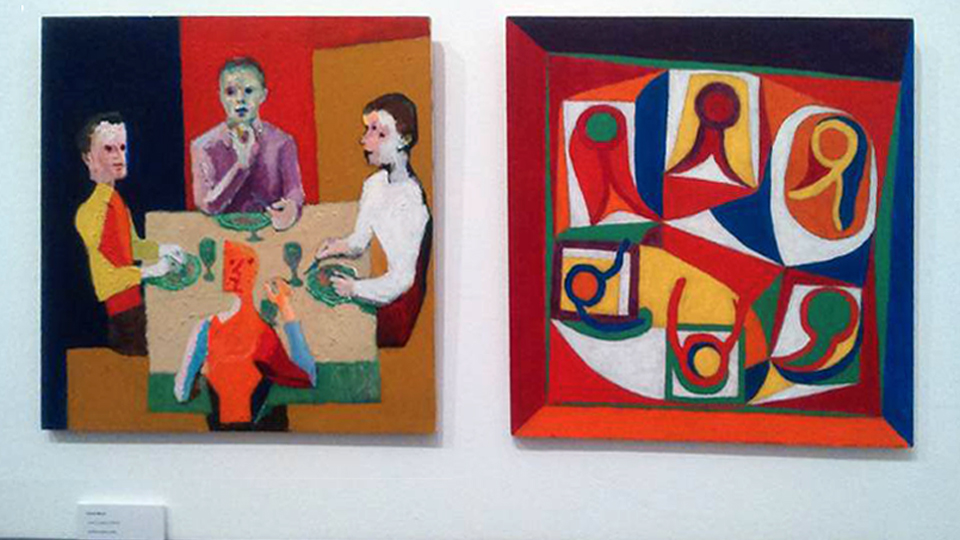
Carlos Bloch - Cena I, Cena II  (2015)

Javier Betancor - Pollo I y II (2015)

Andrés Delgado - Mesa para el jardín de Epìcuro I y II (2015)

martes, 29 de septiembre de 2015

lunes, 28 de septiembre de 2015

Papel engomado 8, La Cena


El viernes 25 de Septiembre a las 20.00 h. en El estudio de Andrés Delgado (C/ San Millán, 2 - 2º A. Madrid) se presentó el octavo número de la revista-objeto "Papel Engomado 8 La Cena", edición al cuidado de Paco Rossique, y que muestra múltiples visiones del acto de cenar. 


Es la primera vez que la revista-objeto es dirigida a modo de comisariado. De hecho, dos exposiciones la acompañan. 

También es la edición con más participantes, doce para ser precisos: Joaquín Artime, Karina Beltrán, Luna Bengoechea, Javier Betancor, Carlos Bloch, Andrés Delgado, Eva Hiernaux, Mar Lozano (aunque con obras solo en la exposición), rosa mesa, Ricardo Montesdeoca, Acaymo S. Cuesta y Adassa Santana son los artistas que dan vida a esta entrega de color azul zafiro.


La muestra también se pudo ver el domingo 27 de Septiembre de 12.30 a 15.00 h. Y se podrá ver el viernes 2 de Octubre de 20.30 a 22.30 h. y el domingo 4 de Octubre de 12.30 a 15.00 h.


Preparación de las cajetillas de Papel engomado 8


Staff del número 8


Pronto la muestra y el número 8 de Papel Engomado viajarán a Las Palmas de Gran Canaria, donde se presentarán en S/T espacio cultural a partir del 13 de Noviembre.

jueves, 17 de septiembre de 2015

miércoles, 16 de septiembre de 2015

Collages & Dispersions en "The Sound Projector Radio Show"


LIFE IS A CARNIVAL


The Sound Projector Radio Show
Friday 11th September 2015

  1. Uneven Eleven, ‘Combustible Combestible’
  2. Reg Bloor, ‘Carnival Of Tragedy’
  3. Kayaka, ‘Pickled Tango’
  4. Papal Bull, ‘Poppies, Cocks and Clipper Ships’
  5. DunningWebsterUnderwood, ‘Tuskcabstems’
  6. Reg Bloor, ‘Unstrumental’
  7. Carlo Costa Quartet, ‘Pulverize’
  8. Peter Brötzmann, ‘The Very Heart Of Things’
  9. Martin Archer and Bo Meson, (Track 03)
  10. Paco Rossique, ‘Blind and Deaf Landscape’
  11. Kayaka, ‘Tropic Of Cancer’
  12. Papal Bull, ‘Snout Leather Is Softest’
  13. Paco Rossique, ‘Islander Tags (Approaching Penelope)’
  14. Carlo Costa Quartet, ‘Soak’
  15. Martin Archer and Bo Meson, (Track 10)
  16. DunningWebsterUnderwood, ‘Grapefleckserpent’
  17. Uneven Eleven, ‘Dune 11’
1, 17 from Life At Cafe Oto, BELGIUM SUB ROSA SR391 (2015)
2, 6 from Theme From An Imaginary Slasher, USA SYSTEMS NEUTRALIZERS 05 (2015)
3, 11 from Sonic Kitchen, UK ADAADAT ADA0040 (2015)
4, 12 from Argot of Incomprehension, UK SINGING KNIVES SK023 / DISCOMBOBULATE BOB006 (2015)
5, 16 from Bleed, UK ADAADAT ADA0039 (2015)
7, 14 from Sediment, USA NEITHER NOR RECORDS n/n 001 (2015)
8 from Münster Bern, SWITZERLAND CUBUS RECORDS CR 371 (2015)
9, 15 from Echoic Enchantment, UK DISCUS 52CD (2015)
10, 13 from Collages & Dispersions, UK LINEAR OBSESSIONAL RECORDINGS LOR063 (2015)

miércoles, 26 de agosto de 2015

Review de Collages and Dispersions en AMN Reviews.

AMN Reviews: Paco Rossique – Collages & Dispersions [Linear Obsessional LOR063]

POSTED ON 

a3524355926_16Collages & Dispersions, a solo recording by Canary Islands pianist and sound artist Paco Rossique, is an atmospheric recording that presents the sonic portrait of an invented, artificially resonant space in which small metal objects are tossed about in a humming wind.
For Rossique, a soundscape is above all a work of imagination midwifed by technological means at the service of a sensitive ear. He deftly layers field recordings, prepared piano and electronic treatments into eight interconnected, timbral compositions that emphasize the contrasts between an intermittent low drone and the sharper-edged sounds of prepared piano and objects. The pieces often feature a counterpoint of electronic washes and clanging metal occasionally giving way to recognizable pitches and tone clusters. The voices of birds and humans appear sporadically, grounding this otherwise otherworldly audio landscape in the concrete sounds of the everyday as filtered through Rossique’s unique sensibility.
This is a sensibility that doesn’t limit itself to the manipulation of sound. The eight tracks are held together in a kind of anti-narrative by virtue of a series of prose poems and visual images, all by Rossique, each one of which is associated with an individual track. These verbal and pictorial tableaux, like their audio counterparts, display a dreamlike logic rooted in the juxtaposition of unlikely elements—a convulsive beauty, as the Surrealists would have it.

viernes, 21 de agosto de 2015

jueves, 20 de agosto de 2015

Review de Sonho perdido en AMN Reviews.

AMN Reviews: Chambel, Duplant, Rossique – Sonho Perdido [Audiotalaia at077]

POSTED ON 

at077aSound is a momentary ripple that disturbs the air and then just as quickly is gone. With Sonho Perdido, a slowly developing suite in four parts, Pedro Chambel (electronics), Bruno Duplant (electroacoustic devices) and Paco Rossique (piano, percussion and electroacoustic devices) take this fundamental observation as their starting point. The predominant mood is of ephemerality, of the presence of sound as being haunted by its impending absence. At the center of the suite are piano tones poised on the brink of a silence that itself is wrapped in a drifting electronic mantle. Rossique’s piano part seems to be an etude devoted to depicting sound envelopes—rather than melodies, there just is the immediate onset and long slow decay of a note into the unhurriedly modulating ether of Chambel and Duplant’s electronics. The music is accompanied by a liner note featuring Rossique’s long poem interweaving allusions to shadows and sound, which is quite nicely in the spirit of the music.

lunes, 20 de julio de 2015

Luján (Smooth VI Number 47 bis)


Banda sonora para "Cuaderno de viaje para una exposición", dentro de la exposición "José Luján Pérez - El hombre y la obra 200 años después". San Martín Centro de Cultura Contemporánea, Del 28/04/2015 al 30/08/2015, Las Palmas de Gran Canaria.

jueves, 16 de julio de 2015

Review de Collages & Dispersions en we need no swords


Paco Rossique: Collages and Dispersions
 / 

Rossique

This album of electronics, field recordings and prepared piano pieces from Canary Islander Rossique is so atmospheric you can almost taste it. Those familiar with Rossique’s previous releases – such as 2013’s Caves or last year’s Resounding Graphic – will have an idea of the aesthetic approach: ominous synth drones, criss crossed by fragments of piano and distant voices, and underpinned by irregular, percussive strikes of stone and metal.

On Collages and Dispersions Rossique has pared things down from the closely-woven spookiness of those previous records. The vibe is unsettling, displaced and, although the recordings are often drenched in reverb, are strangely claustrophobic. There’s a drier, almost mustier feel on tracks like The Long Waiting or The Space of a Door, as if they’re hewn from the volcanic Canary Island rock to form elemental, cubist structures.

It’s that cold, still feeling you get from being inside a vast underground cave – or occasionally a deserted building – with the constant squeaks and scuffles of nature going about its business magnified into nameless terrors by the twin lenses of the reverberant space and the repressed memories of the listeners deep unconscious. Fears from the ancient lizard brain…

There’s a departure from the template on Parallel Roles, its opening hubbub of voices and drones reminiscent of Radioactivity-era Kraftwerk. The voices fade after a while, replaced with machine-like clanks and layered washes of synth, before returning towards the end. They’re slowed down this time, slurred, which adds to the narcotic, hallucinatory feel.

In After Noon O, a series of hollow, mournful whistles rise up from the deep. I’m reminded of Arve Henriksen’s early solo recordings, Sakuteiki perhaps. These simple melodic figures could be calling to us from across time and space, looping away and disappearing before we can adequately grasp them, as the lower register rustles and prepared piano base notes beaver away like mysterious excavations.

Preparations for rituals we’ll never experience. Despatches from the outer reaches.